Superstition and esotericism are hardly unique to Argentina, but few countries have embraced them with quite the same creativity or persistence when it comes to one of their greatest passions: football
Legend has it that at the 1986 World Cup, a manager banned his squad from eating chicken during training camps because it brought bad luck. He dictated the order in which players entered the pitch, arranged for a specific player to answer a phone call at a precise moment, insisted the team listen to the same songs on the bus to every match, and made sure they always had the same barber. All in the name of keeping fortune on their side.
Argentina won that World Cup. And its manager, Carlos Bilardo, walked away not only with the trophy but with a reputation as the most superstitious, obsessive coach in the history of the game.
The popular mythology surrounding that title has a spin-off: before the tournament, the players allegedly visited the Shrine of the Virgin of Copacabana in Jujuy and vowed to return if Argentina won. They never did.
Many Argentines blame that broken promise for every final lost between 1990 and 2014 — three finals, three defeats. It wasn’t until 2022 that the curse, whatever its origin, was finally broken.
Cábala The word “cábala” — the local term for these rituals — has distant origins. It derives from the Hebrew Qabbaláh, meaning “received tradition.” As a discipline, Kabbalah is the Jewish tradition of what religious scholars broadly call mysticism: the esoteric interpretation of Judaism as it appears across its various texts.
In its popular Argentine adaptation, the term refers to the rituals, habits, and charms used to attract or hold onto good luck.
Cábalas serve to ease the anxiety and uncertainty that come with events beyond our control — like a football match. They offer the comforting illusion of having some say over the unpredictable.
Religious faith and superstition often intertwine in these rituals. Ahead of the 2026 World Cup, Messi asked God for protection, while journalist Walter Queijeiro took his special boots — named El Último Tango — to be blessed at the Basílica de Luján, one of the most important Catholic shrines in Argentina.
Whether any of it actually works is, of course, impossible to prove. But try telling that to an Argentine on match day.
At-home rituals before a game Once Argentina wins a match, the cábala demands that every step be repeated for the next one. Fans must recall exactly what they did that day and follow the same routine from the moment they get out of bed.
If replicating everything isn’t possible, certain things are non-negotiable: sitting in the same spot, watching the game with the same people and on the same channel.
Repetition rituals can spiral into extraordinary detail — all in the name of keeping the streak alive. Wearing the same shirt (unwashed) and not changing the TV set for the entire tournament are also firmly on the list.
Gestures like making cuernitos — a hand sign resembling horns — are commonly used to jinx the opposing team. Along similar lines, putting a rival player’s name in the freezer draws on the classic superstition of “freezing” someone to wish them bad luck.
This one, however, is generally discouraged: acting negatively toward others tends to activate karma, and what goes around comes around. The safer alternative is to stick to protective rituals — lighting candles at altars to saints or patron figures, always from a place of positive intention.
Watch your mouth Most oral superstitions share a common thread: never tempt fate by saying something out loud. First and foremost, you cannot celebrate a goal before it happens. If a play is heading that way, restraint is essential — until the commentator calls it or the ball hits the net, you stay quiet.
More broadly, during and before matches, you cannot say “we’re going to win” or “we’re going to be champions.” And if someone accidentally jinxes the team, there is only one remedy: saying “Anulo mufa!” — a ritual cancellation of bad luck, spoken aloud with conviction, ideally while touching wood. Argentina does not take chances.
It has also become increasingly common to hear Argentines shout “Kiricocho!” at the screen — especially during penalty shootouts — to curse the opposing team.
The practice traces back to Argentine football tradition, where a designated person — usually someone considered unlucky or a mufa — would be sent to sit near the rival team’s bench during a match, in the hope that their bad luck would rub off.
The most popular origin of the term is attributed to fitness coach Héctor Kiricocho Bracuto, who worked with several Argentine clubs in the 1980s. Whenever he approached the opposing bench during training sessions, that team would perform poorly.
His colleagues began deliberately sending him to sit near the rival dugout — and the ritual worked so well that his nickname became synonymous with the practice.
At the 1986 World Cup, Bilardo is said to have used the tactic as well, allegedly dispatching Kiricocho to lurk near the opposing bench before matches.
One more rule: if you make a promise — especially to God — you must keep it. Always. Broken vows invite curses, as the story of the 1986 World Cup allegedly proves.
Claudio Chiqui Tapia, president of the Argentine Football Association (AFA), took the 2022 World Cup trophy to both the Basílica de Luján and the Shrine of the Difunta Correa to give thanks for what had been asked. A debt repaid.
On the pitch In Argentina, players traditionally step onto the pitch with their right foot first. But that is just one of the rituals the Albiceleste observe in the hope of bringing good luck.
One of the most well-known current rituals involves Rodrigo De Paul and Leandro Paredes, who eat chewy candies in the center circle before every match — a cábala so iconic it was featured in a Visa advertisement about World Cup superstitions.
The tradition stems from a childhood memory of De Paul’s: his grandfather used to walk him to school and would hand the boy his last few coins to buy sweets — then he would walk home, having spent his bus fare. The ritual is a tribute.
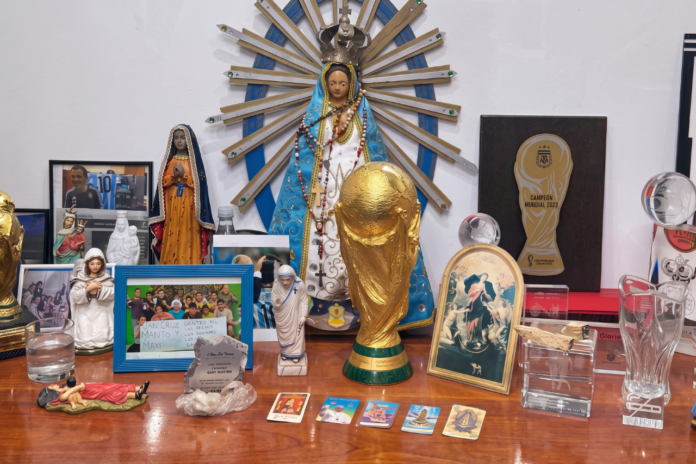
A recently published photo revealed that inside the Argentina dressing room, the squad assembles an improvised altar that captures the syncretism — the blending of the sacred and the secular — that defines so much of Argentine culture.
The team asks for a fourth star in front of images of the Virgin of Luján, the Difunta Correa, the Virgin Untier of Knots, Saint Expeditus, the Virgin and Child, and a bottle of holy water bearing the image of the Virgin of Luján.
Just to be safe — as we noted above — anulo mufa.