CONICET, Argentina’s top publicly-funded research institute, which earlier this year enthralled hundreds of thousands of viewers with a live-streaming from the floor of the South Atlantic near the city of Mar del Plata, has taken a new dive into the Argentine sea, this time to explore the darkest, deepest parts of the ocean off the coast of Chubut, in the Patagonia.
Once again, the exploration is being streamed on the YouTube channel of the Schmidt Ocean Institute, which provided the resources and equipment to carry out the exploration in collaboration with the CONICET.
It comes just four months after their streaming of the Mar del Plata canyon caused an internet sensation and a newfound defense of Argentine state-funded science, which has suffered drastic cuts under the Javier Milei government. The team recently won a Martín Fierro award for best streaming show of 2025 in Argentina.
Scientists have already found a companion for the popular Mar del Plata fat-bottomed starfish (estrella culona in Spanish), the biggest “celebrity” from the first streaming, that made it to t-shirts and mugs when the previous live deep dive was aired, between late July and early August this year.
The team found a new specimen of the Hippasteria phrygiana starfish off the coast of Chubut, although this one’s “buttocks” were not as noticeable, and the researchers joked that it needed to do more exercise.
Scientists had explained that an effect similar to having buttocks is seen in these types of starfish when they are in an upright position and their organs drop to the bottom of their bodies.
“Señoras y señores, es una estrella culona”
Durante el stream de Schmidt Ocean junto al Conicet, los especialistas contaron que es “más chiquita” de la que se había hecho viral, señaló que “no tiene los glúteos marcados” y bromearon: “No ha hecho muchas sentadillas”. pic.twitter.com/CiSfXwOX2O
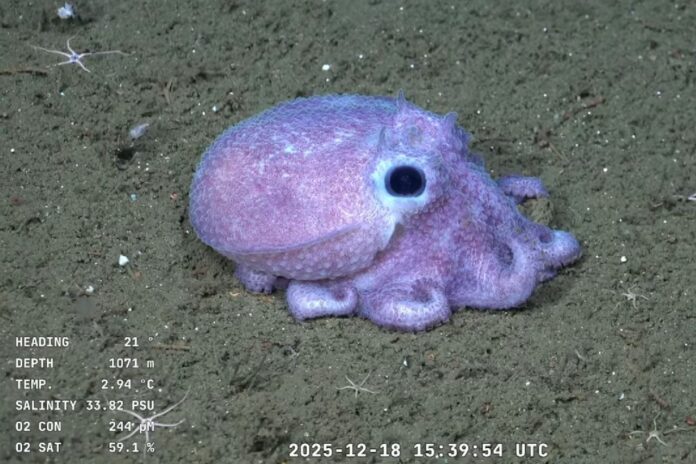
— Corta (@somoscorta) December 19, 2025 In recent days, the researchers and social media users alike were also in awe of a small octopus that appeared to be “falling asleep” while being caught on camera. “It’s closing its little eyes!” one of the scientists said during the stream. It was a specimen of Graneledone boreopacifica.
🐙 ¡Conocé al nuevo pulpo que captó el streaming “Vida en los extremos” del CONICET!
🦑 Por lo que se ve en las cámaras, se trata de un pulpo verrugoso del género Graneledone boreopacifica. pic.twitter.com/3bywrRYRL3
— Filo.news (@filonewsOK) December 19, 2025 On Monday, during a dive over 2,600 meters into the ocean, scientists also found a VHS tape. They retrieved it and saw a starfish was attached to it. “Maybe we can still return it to Blockbuster,” they joked.
Patagonia expedition The “Life in the extremes” exploration began on December 14 and is scheduled to end on January 10. It is led by Dr. María Emilia Bravo, a researcher from the CONICET and the Faculty of Exact and Natural Sciences of the University of Buenos Aires (UBA).
She is working with a team of local and international scientists from several universities and institutions.
Just like in the Mar del Plata expedition, the scientists are on board the Schmidt Ocean Institute’s Falkor boat and are using a remotely operated vehicle (ROV) called SuBastian, which has a 4K camera attached to record the depths of the ocean in high quality.
The goal is to “undertake the first and most comprehensive visually guided study of Argentina’s cold seeps,” said a statement from the institute. The cold seeps are ecosystems created when methane and other gases rich in energy escape from certain areas of the ocean floor where there is no sunlight. Animals and microbes consume the energy from the gas to nourish themselves.
During the exploration, the scientists seek to “understand how the animal communities live and interact with localized physical, geological, and chemical conditions as well as with surrounding deep-sea ecosystems.”
They also aim to examine the amount and type of microplastics in the water, which will help provide data for managing resources and monitoring the impacts of industrial activities and climate change.