This is the latest in Martin Eayrs’s series on birding in Argentina. Previous installments include Buenos Aires City, Bañado La Estrella in Formosa, and Parque Nimez in Patagonia.
Jutting into the Atlantic like a beckoning finger, the Valdés Peninsula is one of the most remarkable wildlife areas in the Southern Hemisphere. This semi-desert region in northern Patagonia is perhaps best known for its whales and orcas, but for birdwatchers it offers an equally compelling mix: marine cliffs crowded with penguins and cormorants, saltpans dotted with Chilean flamingos, and a wide sweep of Patagonian steppe populated by rheas and endemic passerines. The whole area is recognized by UNESCO as a World Heritage Site for its outstanding biodiversity and marine mammal colonies.
In birding terms, Valdés is three habitats in one. Along the coast of Golfo San José and Golfo Nuevo you’ll find beaches, cliffs and rocky points that support colonies of Magellanic penguins, several cormorant species, terns and gulls, plus a rotating cast of pelagic visitors. Coastal hotspots such as Punta Norte, Caleta Valdés and Punta Pirámide add a second layer: sea lions and elephant seals on the shoreline, with Southern Right Whales, dolphins and — if you’re lucky — orcas offshore, a combination that’s hard to beat anywhere in the world. Inland, salt flats and shallow lagoons bring a different scene entirely.
Around Isla de los Pájaros and other wetlands you can often see Black-necked Swans, Chilean Flamingos, stilts and migrant shorebirds. On a calm day, the mirror image of feeding flamingos against the pale steppe feels like a postcard come to life.
Black-necked Swans. Credit: Martin Eayrs. Beyond the coast, the interior of the peninsula is classic Patagonian steppe: low bushes, endless horizons and sudden, wind-carved ravines. Here you can find Lesser Rhea (choique) striding between bushes, Elegant-crested Tinamou rushing from under your feet, and local species such as Patagonian Canastero, Band-tailed Earthcreeper, Patagonian Mockingbird and Burrowing Parakeet. Mixed in with the birds are guanacos, Patagonian maras and foxes, with raptors overhead and Burrowing Owls on and under the ground.
The real magic of Valdés is the way the birdlife overlaps with that of the peninsula’s famed marine mammals. You can watch a flock of oystercatchers while an elephant seal heaves itself ashore, or count penguins with Southern Right Whales blowing or leaping on the horizon. It is this layered experience that sets Valdés apart from most inland birding sites.
Lesser Rhea (choique). Credit: Martin Eayrs Getting there
Most trips start in Puerto Madryn, a coastal city roughly 1,300–1,400 km south of Buenos Aires and well connected by air and long-distance bus. From Madryn it is about 90 km by road to Puerto Pirámides, the only village on the peninsula and the usual base for whale-watching and coastal excursions. There are flights from Buenos Aires to Madryn, or to nearby Trelew.
Access to the reserves is regulated, and the main sites — Punta Norte, Caleta Valdés, Punta Delgada, Isla de los Pájaros and others — are linked by gravel (ripio) roads. An entrance fee is charged to enter the protected area. Many visitors join day tours from Puerto Madryn or Puerto Pirámides, but self-driving is perfectly doable in good weather if you are comfortable with long gravel stretches and keep an eye on fuel. There’s a good selection of accommodation and food options in Pirámides and also the Automobile Club Service Station, the only local source of fuel.
You would be advised to check entry fees and road conditions in advance with the Chubut tourism authorities or the Valdés Peninsula protected-area administration. Note that if the wind lifts too high, sailing out to see the whales may be suspended.
When’s the Best Time to Visit?
Technically you can bird Valdés year-round, but seasonality matters if you want the full spectacle. Many birders like to combine a visit with seeing the whales, which generally arrive in June and stay until December, with a peak in numbers around September–October. More than 2,000 whales were registered here in 2025, making it one of the world’s most important breeding grounds for the species.
Magellanic Penguins return to their colonies in September, with courtship and nest-building in September–October and chicks hatching from October into December. Penguins remain on the peninsula until about March, and can also be seen in large numbers south of Madryn, in the Punta Tombo colony. The best season to visit Punta Tombo is September to March; penguin chicks can be seen November to January.
Magellanic Penguins in Punta Tombo If your focus is birds but you still want whales in the background, September to early December is often recommended as the optimum window, when you can see whales, penguins, breeding sea lions and elephant seals, plus flamingo,s spring passerine activity and migrant shorebirds at inland lagoons.
Why You Should Visit the Valdés Peninsula
World-class biodiversity in a compact area; penguins, whales and rheas in a single day, something very few sites on the planet can match.
Endemic and range-restricted birds; tinamous, canasteros and steppe passerines, alongside coastal species like steamer-ducks and flying seabirds.
Iconic wildlife behaviour; at Punta Norte and parts of Caleta Valdés, the orcas are known for intentional stranding (beaching) to catch sea-lion and elephant-seal pups — a dramatic hunting technique seen in very few places. This can, with good luck, be observed late Feb–May and Oct–Nov.
Conservation significance; as a UNESCO World Heritage Site, a Ramsar wetland and a key marine reserve, Valdés is central to the protection of southern right whales and multiple seabird and shorebird populations.
Accessible yet wild. Good infrastructure around Puerto Madryn and Puerto Pirámides means you can enjoy serious birding and wildlife watching without multi-day treks or technical logistics. A Small Selection of Birds You Might See
This is not a checklist, but a flavour of some species you might see.
For fuller lists, see the dedicated birdwatching pages on www.peninsulavaldes.com.
Waterfowl Black-necked Swan (Cygnus melancoryphus) – Elegant, long-necked swan of lagoons and estuaries, often in family groups. Chilean Flamingo (Phoenicopterus chilensis) – Loose flocks feeding in shallow saline lakes, adding a splash of pink to otherwise monochrome steppe. Upland Goose (Chloephaga picta) – Common grazing species in pairs or family parties, sometimes surprisingly tame around estancias. Steamer-ducks (Tachyeres spp.) – Heavy, mostly flightless ducks seen riding the surf near rocky shores; Chubut/Flying Steamer-duck is a regional speciality. Streamer duck. Credit: Marrtin Eayrs Shorebirds
American Oystercatcher (Haematopus palliatus) – Striking black-and-white bird with orange bill, common along rocky and sandy shores. Two-banded Plover (Charadrius falklandicus) – Neat, compact plover of beaches and salinas, often in small flocks. Magellanic Oystercatcher (Haematopus leucopodus) and other plovers/sandpipers appear on migration or in suitable habitat, so a simple scan of any tidal flat usually pays off.
Landbirds Lesser Rhea / Choique (Rhea pennata) – Large, flightless bird of open steppe; a signature silhouette on any Valdés road journey. Elegant-crested Tinamou (Eudromia elegans) – Portly, quail-like bird that explodes from low cover; its whistling calls are often heard before dawn. Patagonian Canastero (Pseudsthenes patagonica), Band-tailed Earthcreeper (Ochetorrhynchus phoenicurus) and White-throated Cacholote (Pseudoseisura gutturalis) – Classic Patagonian passerines favouring scrub and thorny bushes; excellent targets for more experienced birders. Burrowing Parakeet (Cyanoliseus patagonus) – Noisy groups commuting between nesting cliffs and feeding areas, adding colour and sound to the steppe. Around settlements, expect Rufous-collared Sparrow, assorted finches and tyrant flycatchers. Burrowing Parakeet. Credit: Martin Eayrs Birds of Prey
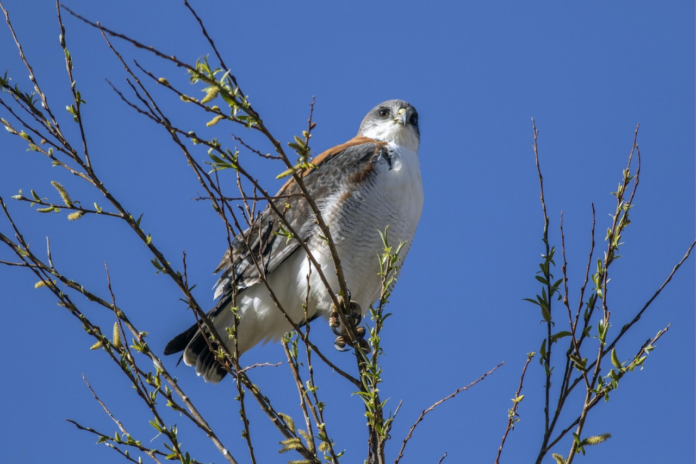
Chimango Caracara (Milvago chimango) and Crested Caracara (Caracara plancus) – ubiquitous scavengers and opportunists, often perched on fenceposts or feasting on carcasses. Variable Hawk (Geranoaetus polyosoma) – Broad-winged raptor seen soaring over the steppe or hovering into the wind. Burrowing Owl (Athene cunicularia) – Small, long-legged owl sharing burrow systems with maras and cavies; easily seen by the roadside in the late afternoon. Burrowing Owl Crested Caracara Offshore, keep an eye out for skuas, giant petrels and terns, especially in breezy conditions that bring them closer to shore. You might even see an albatross if you’re lucky.