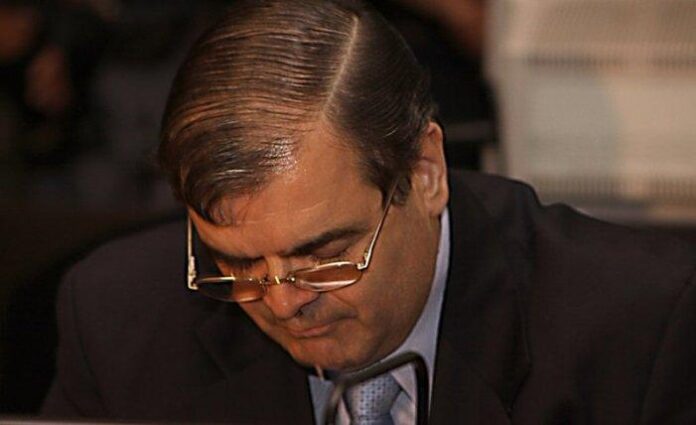
A Buenos Aires City federal court has granted probation to Eduardo Kalinec, a former senior police officer who had been sentenced to life in prison in 2010 for torture and murders committed during the military dictatorship (1976-1983).
Kalinec, known by his victims as “Doctor K,” served as the Federal Police commissioner during the dictatorship. He was convicted for crimes committed in three clandestine detention centers in Buenos Aires City: Atlético, Banco, and Olimpo.
The decision was made on Monday by the Oral Federal Tribunal No. 2 following a ruling by the 4th Chamber of the Federal Criminal Cassation Court last week. That latter ruling was crucial, as it backtracked a ruling the court made in September denying Kalinec probation.
The basis for the refusal was the gravity of Kalinec’s crimes, his lack of remorse, an insufficient prognosis for social reintegration, and international jurisprudence on crimes against humanity.
The court quoted a report by the Interdisciplinary Penal Execution Team that stated that Kalinec does not hold “a responsible attitude regarding the facts for which he was convicted, that he has not undergone nor considers it pertinent to undergo psychological treatment, and that, in synthesis, he has not shown a reflective attitude.”
The new ruling Last week, however, the cassation chamber, with a majority opinion by Javier Carbajo and Gustavo Hornos, reversed its previous opinion and said Kanilec met the temporal requirement for a parole, as he has been detained since September 1, 2005. In convictions of serious crimes, however, Argentine law states that judges must get technical reports on the inmate’s behavior.
The judges quoted a report filed by the Ezeiza Penal Colony, where Kalinec is imprisoned, stating that he had “complied with prison rules and regulations and had shown adequate progress in the prison system.”
That brief also noted that he had “a favorable prognosis for social reintegration and took temporary leave for family bonding.” It added that he has “strong family ties” with “his daughters, who are willing to continue supporting him.”
Kalinec has not spent his time in prison silently. He filed a civil lawsuit against one of his daughters, Analía, for being “unworthy,” seeking to prevent her from receiving her mother’s inheritance. Analía, a member of the Historias Desobedientes collective, made up of children of dictatorship repressors, was the only one of his four daughters to publicly disown him.
In November 2021, Kalinec also filed a request to be considered a plaintiff in the case involving a bomb planted by militants in a Federal Police building that housed a clandestine detention center, arguing that he suffered injuries.
Even before coming into office, President Javier Milei had been vocal in his disdain for Argentina’s memory policies, which have been put in place to seek justice for victims of the country’s last dictatorship. Since the start of his tenure, he has turned his comments into state policy, axing funding to the agencies in charge of those human rights policies.
Agustín Cetrángolo, son of Sergio, a victim of the dictatorship who was detained and disappeared in one of the clandestine centers Kalinec managed, said the ruling was “expected.”
“Very few genocidal criminals remain in regular prisons,” he told the Herald. Cetrángolo, who is a plaintiff in the case against Kalinec and an activist of the HIJOS human rights group, said that the judiciary “is currently permeable to the impunity that sectors of the government want to generate.”
“We are faced with increasingly more unfavorable rulings. It is what we have to deal with at the moment, and it is why we will continue to fight, marching and demanding justice and punishment,” he added.