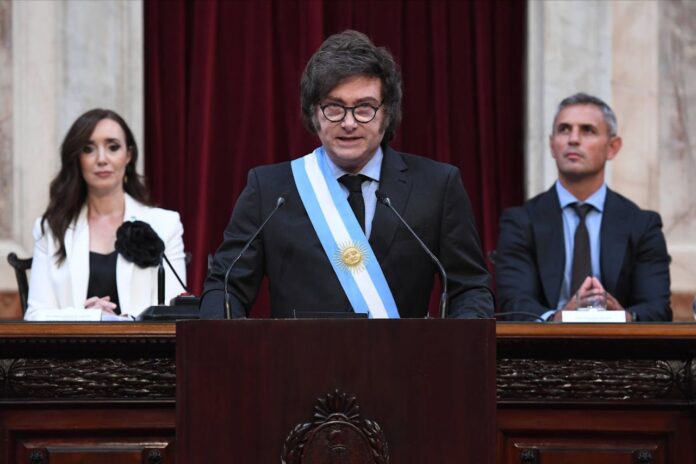
President Milei has formally called for extraordinary sessions of Congress to be carried out between December 10 and 30. On Wednesday, the government will file bills aimed at passing reforms in labor, tax, and fiscal matters. The docket also includes the 2026 budget and a project to change the existing national glaciers law.
The government is aiming to debate and pass these key reforms in just 20 days and smack in the middle of the holiday season. Here’s a breakdown of what these projects entail and why they waited until now to send them to Congress.
The new lawmakers The main reason is legislative support. The date for the extraordinary sessions was timed to coincide with the beginning of the recently elected lawmakers’ term on December 10. Following their landslide victory in the October midterms, ruling party La Libertad Avanza (LLA) is set to go from 47 to 95 out of the total 257 deputies.
They will have the largest bloc in the lower house, giving it enough seats to block impeachment requests and uphold presidential decrees. The added support of right-wing party PRO and other smaller blocs will likely guarantee a much smoother path for the government and a harder time for the opposition.
In the Senate, LLA will go from its current 6 senators to 20 out of the 72 total seats.
Labor reform Milei’s labor reform is arguably the most important bill set to be filed. The president insists on calling it a “labor modernization” proposal, aimed at loosening the rules regulating employment in Argentina and discouraging litigation against employers.
Despite being part of the so-called May Group that debated the reforms, Argentina’s most influential trade union federation, the General Confederation of Labor (CGT by its Spanish acronym), decided not to take part in the project. A CGT source told the Herald they reject the project.
The Herald has seen a draft of the bill proposal. Among its main changes is the creation of layoff funds to replace the current severance system. These funds would be financed by payments made by employers each month, effectively reducing the amount of money they would have to pay for layoffs without cause.
Another change unions oppose is allowing workers to potentially be paid in pesos, foreign currency, or food and other products, while salaries could also be tied to productivity. The project also aims to create an hour registry of employees’ work, meaning they could be requested to stay after hours when needed and later take time off accordingly. These extra hours, however, would not be considered overtime and therefore would not be paid as such.
The bill also seeks to strip unions of some of their bargaining power. In Argentina, wage negotiations have traditionally taken place within each sector (think banking or retail workers) and later applied to its members regardless of who their employers are. The proposed changes would allow each company to carry out these negotiations on their own.
2026 budget Milei filed the 2026 budget bill in the lower house in September. The bill includes increases in pensions, education, and healthcare, with the government claiming that 85% of expenditures will be destined to these sectors.
The norm also includes a rule to guarantee fiscal balance, an area the president considers “non-negotiable”: if there is a drop in government revenue or expenditures are larger than expected, the budget will have to be adjusted to restore balance.
This would be the administration’s first budget of their own. Since coming into power in December 2023, they have been operating with the budget approved for that year, handling any public sector funding raises via discretionary increases.
Fiscal and tax reforms The tax reform is aimed at reassessing the tax burden without endangering fiscal balance. According to the government, the reform will cut several taxes and eliminate personal income tax. Chief of Staff Manuel Adorni has said it will help the private sector save millions of dollars.
The government also wants to increase the threshold for which an individual can make a dollar transaction before triggering an investigation for tax evasion. The goal is to encourage people to reintroduce their undeclared savings in U.S. dollars back into the financial system.
Criminal Code Milei wants to reform the existing Crime Code in order to impose stricter sentences, as well as end the statute of limitations for serious crimes like sexual abuse and human and drug trafficking. The project also creates new offenses, such as AI-related cybercrime.
Glaciers The National Glaciers Law protects glaciers and what are known as “periglacial areas.” These are portions of frozen mountain land that are not necessarily glaciers and can defrost depending on the season.
Current legislation bans mining in periglacial areas. The government’s bill is a proposal aimed at allowing provinces to decide themselves the extent of these protected areas and whether they want to allow mining or not.
The proposal has reportedly been backed by the governments of Mendoza, San Juan, Catamarca, and Jujuy, four provinces with important mining resources.