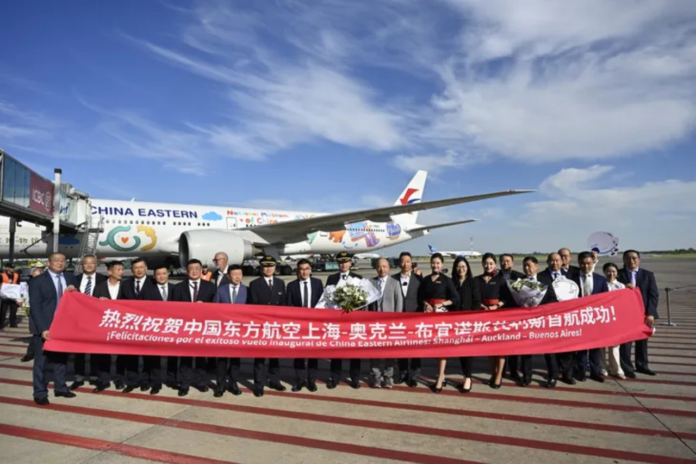
Greetings in Mandarin, special menu options in airport restaurants and a steady supply of cups of hot water are part of the welcoming now awaiting Chinese tourists arriving in Argentina on China Eastern’s new Shanghai–Buenos Aires route.
The inaugural flight that landed on Thursday marked a milestone in intercontinental connectivity. Apart from restoring a link to Asia that disappeared more than a decade ago, the service is now the world’s longest commercial flight — covering about 20,000 kilometers in roughly 26 hours, with a technical stop in Auckland, New Zealand.
The route operates as a direct service with an intermediate stop in Auckland. Flight MU745 departs Shanghai Pudong at 2 a.m. local time, lands in Auckland in the afternoon and, after a two-hour layover, continues to Buenos Aires, arriving the same afternoon thanks to an 11-hour time difference.
MU745 will operate Mondays and Thursdays, leaving Shanghai at 2 a.m. and landing at Ezeiza International Airport at 4:30 p.m. the same day. The return flight, MU746, departs Buenos Aires on Tuesdays and Fridays at 2 a.m. and reaches Shanghai 29 hours later, including the Auckland stop.
China Eastern will use Boeing 777-300ER aircrafts fitted with six First Class suites, 52 Business seats and 258 Economy seats.
Argentina reconnects with Asia
Argentina lost its direct connection to Asia in 2012, when Malaysia Airlines ended its Buenos Aires–Kuala Lumpur service, via Cape Town in South Africa, for commercial reasons.
The new connection is generating strong expectations, as Argentine tourism officials hope to attract more Chinese visitors, encouraging longer stays. The new offers include itineraries that combine Buenos Aires with Patagonia, destinations on the Andes mountains, the Iguazu Falls and even Antarctica.
On the commercial side, it creates an opportunity for businesses to reinforce logistics for imports and exports, especially amid an ongoing liberalization of trade — reflected in the rise of Chinese e-commerce platforms such as Shein and Temu.
In fact, although not exclusively a cargo aircraft, the B777-300AR is a model that stands out for having a large cargo hold capacity.
Hotels, tourism agencies and local tour providers are preparing to welcome Chinese travelers with offers adapted to cultural preferences, languages and consumer habits.
Agencies specializing in the market offer Mandarin-speaking guides and circuits that include Buenos Aires’ Chinatown and the Japanese Garden for those seeking an urban experience with Asian influences.
Other packages combine the capital city with winery tours in Cuyo or Patagonia excursions to glaciers and natural landscapes. Companies with long experience serving Asian tour groups are updating their catalogs to include Chinese-language menus, translated materials and personalized assistance.
In Mendoza, the “Bienvenido” (“Welcome”) program — launched in April by the city government and the Argentine-Chinese Chamber of Commerce — aims to help businesses adapt to Chinese customs by translating menus and offering services accessible through QR codes.
High expectations The adoption of Chinese payment platforms is another practical change underway. Systems such as Alipay and WeChat Pay, already common in major tourist hubs worldwide, are gradually emerging in Argentina as digital wallet providers expand options for travelers who prefer not to rely solely on traditional cards.
Buenos Aires restaurants are also adjusting to Chinese culinary preferences, offering milder dishes, familiar ingredients, tea stations and meal times that align with tour schedules led by Mandarin-speaking guides.
Local tourism offices have prepared informational materials in Chinese, including guidance on customs and social norms to help ensure a welcoming experience.
The arrival of China Eastern’s first flight also required special coordination at Ezeiza airport. While authorities decided putting up Chinese-language signs was unnecessary — most Chinese travelers navigate easily in English — airport operators took additional steps.
Ground staff were trained in basic Mandarin to assist passengers during disembarkation, help with immigration procedures and provide a warm welcome. Some restaurants introduced special menus, and all are prepared to offer hot water on request — a deeply rooted custom among Chinese travelers.
Originally published in Ambito.com