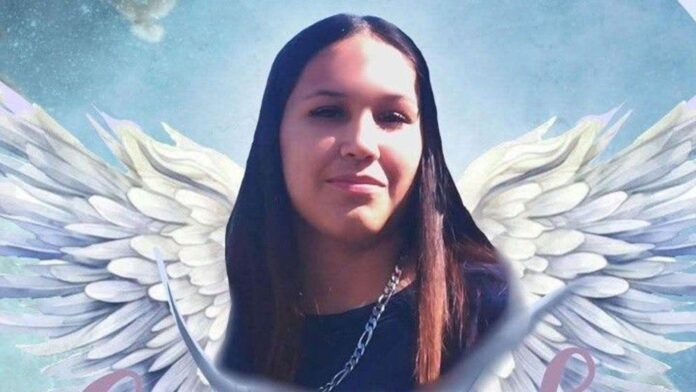
The phrase “One pill can kill” is visible on almost every street in the Mi’kmaq community of Listuguj, in eastern Quebec. Next to the slogan is the image of Savannah Metallic, a community member who died on her eighteenth birthday last June. The word “pill” refers to fentanyl, a powerful synthetic opioid 50 times stronger than heroin. “She wanted to do so many things in her life,” said her mother, Lacey Condo. She describes Savannah as a sweet girl, who constantly wanted to make the people around her happy. But his last memories of Savannah are painful. “I had to walk into the room and see my daughter. She was cold, stiff, blue lips, blue feet, foam came out of her mouth, blood flowed from her nose,” she says. “If they had just called 911, she would still be here,” Condo said of the people who accompanied her daughter. Photo: Jeff Dorn/APTN. Lacey says she found Savannah the day after her overdose. She wishes the people who were by her side at the time of the overdose would do more to protect her. “If they had just called 911, she would still be here.” She would be alive,” Lacey said. “She didn’t deserve this. She had so many reasons to live. » For Lacey, her daughter’s death represents a much bigger problem: the prevalence of drugs and addiction in the community. “Nothing has been done to combat drugs in our community,” she said. “They are still selling the exact same pills that killed my daughter. » Responsibility of traffickers Savannah’s great-aunt, Anita Metallic, wants those responsible to have consequences. Which includes those who profit from selling drugs. “If you sell a pill to someone and that person dies, you should be held responsible,” Anita said. She says that at one point she started receiving threats against her family after speaking out against drug traffickers selling in Listuguj. She was told, “You better calm down or they will come after your family,” which, she adds, made her hesitant to speak out further. Despite this, she continues to demand that traffickers be held accountable. APTN National News spoke with several community members who declined to speak on the record due to threats of retaliation. APTN also contacted the Listuguj Mi’kmaq government several times to understand what was done in the matter. We have not received a response to our request. “How many more people have to die?” How many more children must die? », exclaimed Anita. “No one knows how to handle this situation,” said Anita Metallic, Savannah’s aunt. Photo: Jeff Dorn/APTN. Opioid overdoses: a growing problem across Canada Listuguj is not the only community experiencing the loss of loved ones to opioid overdoses. “No one knows how to handle this situation, communities are struggling everywhere,” said Anita, noting that the threat was spreading to neighboring towns. “Campbellton, Cross-point… they are all facing this problem,” she added. Fatal opioid overdoses are being reported across Canada. British Columbia and Ontario have the highest rates nationally. Just last year, nationwide. In the first three months of 2025, 1,377 fatal overdoses were recorded. APTN contacted the Listuguj Community Social Services Branch and Listuguj Police to obtain statistics on the number of opioid-related deaths in the community. Both services responded that they did not have this data. Tracking opioid data among Indigenous people is a national issue. Canada does not track opioid-related deaths in First Nations communities. In fact, the last statistics provided by Statistics Canada on opioid consumption among First Nations date from seven years ago. Statistics Canada published a report in 2018 on the problematic use of opioid painkillers. This report indicated that First Nations living on reserves were more affected by the harms of opioids, without providing precise figures. Read more: Waswanipi Cree Nation threatens to evict tenants caught in possession of large quantities of drugs Two approaches to addiction aim to help as many homeless alcohol users as possible A year earlier, in 2017, Health Canada released a report on the opioid crisis. Data collected in British Columbia and Alberta showed that First Nations people were three times more likely to die from an overdose. The federal government was only able to release this data because both provinces were tracking opioid overdoses among First Nations people at the time. Even a single death has a catastrophic impact on many lives. “There are days when I can’t get out of bed. I can’t dedicate myself to anything,” Lacey said. “It’s quite simply the hardest thing I’ve ever been through. » Police say understaffing hampers fight against drug trafficking Many community members interviewed by APTN said the Listuguj police were not doing enough to fight traffickers and protect the community from drugs. Last year, the Listuguj police moved into a new, modern building with additional resources for officers. Despite this improvement, police said they are struggling to deal with some challenges, including drugs in the community. She attributes this to a lack of staff. “I don’t know how many years I can count on the fingers of both hands a steady decline in the number of police officers,” Acting Listuguj Police Chief Sharon Barnaby told APTN. She added that there were far more retirements than hires. Tyler MacDonald, criminal investigator for Listuguj police, said another problem police face is multiple jurisdictions and boundaries. He explained that there are three police jurisdictions in a very small area. “We have the RCMP looking after Campbellton, we have the Sûreté du Québec looking after the area around us,” he said. “And then we have our territory here. MacDonald said this can create difficulties when drug investigations cross jurisdictional boundaries. One of the measures taken by police to combat drugs in the community last year was the establishment of an anonymous tip line for reporting information. But, he added, information received through the call line cannot always be used. “We have to corroborate the information,” he said. MacDonald explained that in cases where information comes from a single source, rather than several, police do not use it. “The information must not identify them or compromise their safety, which is one of the reasons they have chosen to remain anonymous,” Mr Barnaby said. “Anonymous information also means that it is up to us to validate it. » Police said they need the community to feel confident that the hotline service will help combat drug trafficking. MacDonald said all drug-related cases were his responsibility, calling it “difficult.” Part of the difficulty comes from the way traffickers react to the police. “What we reveal, they learn, adapt and change,” Barnaby said. “So we must do the same. We need to equip ourselves with more sophisticated tools and increased surveillance on the roads. » “For me, I think it’s up to you to break the cycle,” says Celeste Barnaby. Photo: Jeff Dorn/APTN. Breaking out of the vicious cycle of addiction Celeste Barnaby has been in recovery for almost 12 years. Her addiction isn’t the only time she’s been affected by substance abuse. Celeste also faced addiction in those around her. “My mother is a drug addict and my father was an alcoholic,” she explains. Today, photos memorializing her father and others she lost to drug addiction hang on her refrigerator, including a photo of Savannah. She said it was difficult to watch her two daughters suffer over Savannah’s death. Celeste’s eldest daughter was a childhood friend of Savannah’s. She says that Savannah often came to her house and that she wished she could be there for her, and offer her support. “She couldn’t even live her life,” she said. “I can’t imagine losing my daughter at this age. I would lose my mind. » For Celeste, reducing addiction is partly about breaking the cycle of addiction. To achieve this, she talks with her children about the dangers of drugs and her own experience with addiction. Celeste says she had this conversation with her eldest daughter after she turned 12. She adds that her youngest daughter will soon be 12 and she will talk to her about her experience with addiction after her birthday. Celeste’s daughter attends Sugarloaf Senior High School (SSHS), the same school as Savannah. APTN asked Celeste if SSHS provides information on addiction and substance abuse. She replied that she did not know. APTN spoke with an SSHS student who said the school provides no education or awareness about drug use and only denounces the use of e-cigarettes on school grounds. APTN will not release the name of this student. We contacted the school’s guidance counselors to ask if the school provided substance abuse education. We did not receive a response before publication date. “For me, I think it’s up to you to break the vicious cycle,” Celeste said. “If you want help, you will get it. There are so many resources in our community. » Lacey Condo, seen here in conversation with APTN correspondent Savanna Craig, says the presence of drugs on the streets is painful. Photo: Jeff Dorn/APTN. Resources for people suffering from addiction in Listuguj “They use alcohol and drugs to avoid feeling pain,” says Michael Martin, knowledge keeper and addiction counselor at the Directorate of Community Social Services in Listuguj. “We always return to the source of our addictions. They do not come from alcohol or drugs, but from historical trauma,” he adds. According to Martin, to reduce the number of overdoses in Listuguj, these traumas must be healed. Despite the services offered, he said not all services work in a coordinated manner to combat overdoses and drugs in the community. “My superiors, and perhaps the political world, have things to do. It takes time for them, and for myself, I’m patient about it,” he said. Martin refused to make recommendations on what police and city councilors should do unless invited to the table. Some said the services used to work more together, including Mi’kmaq hereditary chief Gary Metallic, who was a drug counselor in the 1980s. “When we were part of the program “We had a network of police, chief and council,” he said, adding that all social services met once a week to discuss community issues. “I think we need to bring that back,” Gary said. Martin said he is looking forward to spring, as the services offered by the Directorate of Community Social Services in Listuguj will be expanded. He added that these services will be steeped in tradition and offer opportunities to participate in sweat sessions, meat drying and making costumes and rattles. While community members must wait until next spring to benefit from these services, a new center was opened in Listuguj at the beginning of October. The Mawiomi Treatment Center is a non-profit organization serving Indigenous people affected by addiction. The original center has been in operation in Gesgapegiag, in Gaspésie, since 2020. But a second center is now open in Listuguj. Despite the new resources available and those to come, many community members still face the loss of loved ones as drugs continue to circulate on the streets of Listuguj. “ [Ces drogues] are still on our streets, it’s painful to see,” Lacey said. “It’s like a slap in the face every day. » Continue Reading
Listuguj mourns loss of 18-year-old girl, calls for accountability for opioid-related deaths