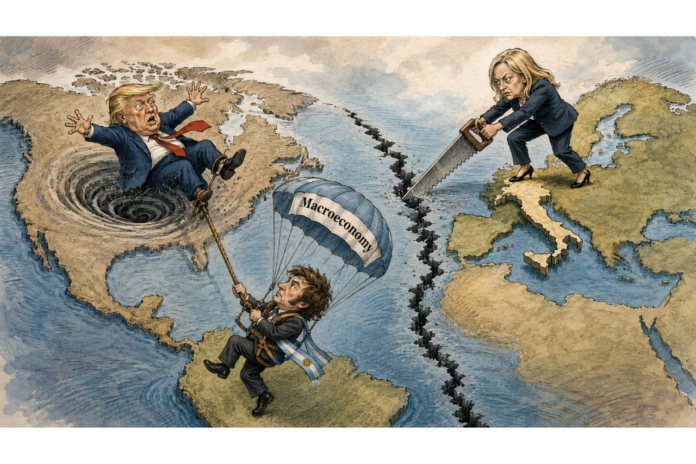
For years, the populist right liked to imagine itself as an international bloc.
Brexit gave it a launchpad in 2016. Donald Trump gave it a flag that same year. Jair Bolsonaro followed in 2018, Viktor Orbn had already built the model in Hungary, and Giorgia Meloni and Javier Milei joined in 2022 and 2023.
Meloni was the only European Union (EU) head of government to attend Trump’s second inauguration, a gesture that set the tone for the role she’d play over the following year as Washington’s preferred contact inside Europe.
That bloc is no longer moving cleanly in formation. The clearest fault line runs through Trump himself: still useful to some allies, increasingly costly to others as his unpopular decisions regarding the war in Iran cast doubts about his party retaining control of Congress in the upcoming midterm elections.
Hungary was the first sign the network wasn’t invincible from within. In April, after 16 years in power, Viktor Orbn lost in a landslide to Pter Magyar’s Tisza party, the first time since 2006 that Fidesz hadn’t won.
JD Vance had campaigned in Budapest for Orbn days before the vote, framing it explicitly as a fight for the European outpost of MAGA, Trumps Make America Great Again populist movement.
The defeat removed the most entrenched member of the network and weakened the case that the model travels.
Meloni vs. Trump The next rupture came through a public quarrel between two of the blocs most influential figures.
The spat between Meloni and Trump had a much more profound origin than what at first could appear as just a clash of egos.
It started with Trump’s unconditional backing of Israel’s military campaign in Gaza, and then the war with Iran, which put him on the opposite side of most European governments and a large share of European public opinion.
Italy declined to let United States aircraft use its base in Sicily during the Iran operation.
Then there was also a domestic issue when Trump attacked Pope Leo XIV as “weak on crime.” Meloni, under pressure at home, publicly defended the pontiff.
Finally came the meeting of the G7, where the American president claimed his Italian counterpart had begged him for a photo and suggested her sagging poll numbers were punishment for the decision regarding the Sicilian base.
Meloni denied the claim and replied that being his friend “has certainly not helped” her popularity. Italian Minister of Foreign Affairs Antonio Tajani then canceled a planned trip to Washington.
That was not routine diplomatic irritation. It was a public recalculation of the value of proximity to Trump.
Meloni had spent the previous year playing the role Orbn could not: a far-right European leader close enough to Trump to serve as a bridge to Washington, but one who respects institutions, works with the EU on migration policies, and cooperates with NATO on Ukraine.
That is why the fight mattered beyond the insult itself.
The feud showed that the alliance of the right is no longer held together by style or ideology alone. It now depends on whether proximity to Trump still serves each leaders domestic interests.
Despite Trump’s criticism, Melonis government’s approval has actually risen to around 35% this year, after a 2025 decline, with her right-wing party Brothers of Italy still leading the polls at 28%.
The Republican, for his part, sits at 36% approval in the U.S. and just 33% on the economy, his lowest marks of either term, according to the latest Marist poll.
Meloni isn’t retreating because Trump is dragging her down. She’s distancing herself from a relationship that has stopped paying off.
Milei, a different story Milei is a different case. Where Meloni calculated her way into proximity with Trump and is now calculating her way out, the Argentine president’s alignment looks like genuine conviction, reinforced by his own closeness to Netanyahu’s Israel.
There is little evidence so far that the Trump relationship itself has become a domestic liability for him. What frustration exists at home is aimed at the cost of the economic adjustment, not at foreign policy.
The real asymmetry is not personal, but structural. Meloni can step back from Trump and retreat into a Europe and an electorate that doesn’t require talking about Washington at all. Milei has no equivalent fallback if Trump’s growing unpopularity starts to resonate back home.
Mexico has moved openly to reduce its dependence on the U.S. through its renewed EU trade deal, while Brazil has pursued a broader strategic-autonomy posture with Europe, China, and other partners.
Milei, by contrast, has built his foreign-policy identity around staying close to Washington, and Trumps Washington has become his most politically visible external anchor, alongside the International Monetary Fund (IMF), markets, and private capital he is also courting to refinance Argentinas debt.
That bet has had real returns. The political alignment with Washington helped unlock the IMF agreement that gave Milei the fiscal breathing room to bring inflation down.
His macro numbers are solid: annual inflation fell to 33.2% through May, from 211% under Alberto Fernndez, and poverty dropped to 28.2% in the second half of 2025 after peaking above 50%.
Those figures are the strongest part of his political case. But they are not the same as relief. Registered wages remain below pre-Milei levels, formal employment is still weak, and the middle class is judging the recovery less by the dashboard than by rent, groceries, school fees, and the possibility of planning more than one month ahead.
The risk for Milei is not that Trump becomes unpopular in Europe. It is that economic improvement remains visible only in macroeconomic data but is yet to become convincing in daily life.
New Members The old populist-right club may be cracking, but Latin America is producing new right-wing entrants of its own though not all of them cut from the same cloth.
Colombia and Peru both just elected the right, with Trumps open backing in Colombias case, even as his own numbers sag at home.
That does not mean the bloc is being rebuilt in the same form. It suggests something messier: Trump may be less useful as a governing partner than as a political language, a symbol, or a shortcut for candidates promising order, confrontation, and a break with the establishment.
Brazils October election will test how durable that pattern is. If the right keeps gaining in the region while Trump loses ground in the U.S. and becomes toxic to some European allies, the populist right will not look like a bloc anymore.
It will look like a set of movements that share a political language but no longer share a strategy.
The populist right is not disappearing. It is becoming less synchronized, less disciplined, and more dependent on what each leader still needs Trump for.