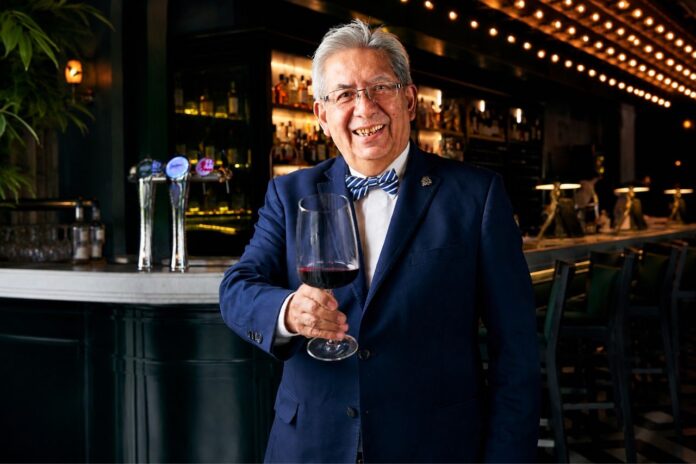
Sommelier Celestino Rodrguezs philosophy is simple: read the room and guide guests toward what they enjoy, rather than turning the experience into a lesson in wine.
One of the first people to graduate as a sommelier in Argentina in 2000, Rodrguez got his gastronomy chops working in the restaurant business from a very early age.
Today, he is the head sommelier in the Michelin-recommended restaurant Cauce in Puerto Madero, where he met with the Buenos Aires Herald and talked about the identity of Argentine wine, his view of the craft, and winemaking in a context of declining global consumption. The following interview has been slightly edited for length and clarity.
How did you start working in the world of wine?
I have been in the gastronomy business my entire life. I started at fifteen as a dishwasher at the Navy Officers Center in Olivos, working Saturdays and Sundays while attending school. There was a gentleman there who was always offering wine, which deeply caught my attention. There was a massive demand for wine back then because people drank it naturally with both lunch and dinner. Later, I trained and graduated as a pastry chef and went on to study a bit of everything: baking, protocol and etiquette, ice cream making, catering… always working in hospitality, but not yet in the wine world. I was working right next to Cabaa Las Lilas in Puerto Madero and I ran into Marina Beltrame, head of the Argentine School of Sommeliers, who was inviting industry workers to the school’s launch. I went the very next day and signed up. I became the first person ever to enroll in a sommelier program in Argentina.
How do you see the wine industry in Argentina, especially considering the decline in consumption globally and domestically?
Argentina produces some of the great wines of the world, ranking at the top in quality and product. If you spend three months in Europe, you will miss Argentine wine. If you spend three months in Argentina, you won’t miss European wine. We have incredible diversity, variety, and quality. That quality comes from the original product: the grape. We have a blessed climate where the harvested grapes look like showgirls coming down the stairs of the Maipo Theater. Conversely, in other regions of the world, the climate is less favorable, making the raw material more complex and less consistent. In France, they charge heavily for a good harvest. Here, even the worst harvest is good. Argentine winemaking is world-class, though its weak point is that the country has never had a stable economy.
Which producers do you think are doing something interesting, innovative, or original?
Mauricio Lorca’s unaged wine is a prime example. He proposed it in 2002, when every local wine spent at least 14 to 18 months in oak. He suggested skipping the barrel because he was looking for something else: if a wine is already finished with such grape quality, why add oak? On the other hand, the most innovative shift in recent years has been learning to interpret our own product. Previously, Argentine winemakers copied Europe, but in 2010, the industry clicked and started expressing our own fruit. That was the great shift, along with the realization that wine could be produced in different regions. We now interpret each specific region. We cannot expect a wine from Chapadmalal to mirror the Uco Valley, the Northwest, or Chubut.
Do you see other grape varieties advancing over Malbec? While it is our flagship, perhaps consumers are looking for something else.
Malbec is what we learned to make first. The best Malbec in the world comes from Argentina. I do not think it is our best wine, but it is our flagship variety. To make it a truly great Argentine wine, Malbec should always be blended with a touch of another variety to add structure and elevate it for global competition. This is not because the wine is bad, but because the grape’s natural characteristics are friendly, sweet, and fruity. I think we have an excellent Cabernet Sauvignon that has always played from behind but has consistently delivered quality. While Malbec remains our flagship, as great Argentine wines, we can produce excellent Malbec, Cabernet, Bonarda, and even Sangiovese.
You didn’t mention any whites
When it comes to white wines, I have become addicted to blends. We have improved immensely with whites like Semillon, Chenin, Chardonnay, and Torronts. Other white varieties still require a lot of development.
Do you think Argentine wine culture has its own identity?
Wine identity is always linked to culture, and food is part of that. The identity of Argentine wine is closely tied to our meats and our dining habits. Our country offers grilled meats, cold cuts, and good cheeses. Having such a diversity of soils expands that culture, but always with a personality based on red wine, which has structure, volume, and weight in the mouth. Wine has a physical presence, but it should feel like a caress as it passes through the mouth. That comes from proper ripening. If you harvest a grape that lacked a single day of sunshine, you cannot fix that even with the best winery technology it has to come from the vine. Our identity lies in that relationship between red meats and structured, high-volume wines that always maintain elegance.
What local wine habit is uniquely Argentine, something a tourist will only see here?
We hold onto our roots and a cultural trait we refuse to let go: the sobremesa the long hours spent around the table together after eating. The conversation and the dialogue. We enjoy wine as a celebrated beverage. We need to look past the rigid idea of “I am so healthy because I don’t drink alcohol.” Many people order chorizo, blood sausage, and sweetbreads and then pair it with a Diet Coke or water. You are killing yourself! Im not being judgemental, but I do advocate for a different approach: why don’t we start with the best wine and the meats first, and leave the fats for the end? Let’s make the hosting experience work from the very beginning. Let’s do it the other way around.
What places in Buenos Aires do you like for a glass of wine?
I am a wine romantic. To talk about wine, I have to personify it and give it a physical structure. To truly enjoy it, I need to set the scene: what wine matches a grey, lonely afternoon? I might order a glass of red simply because I want the color to match the atmosphere. I would love to drink it in front of the museum in Tigre, looking at that French architecture and Gothic space. I cannot talk about wine without incorporating that play of curves, twists, and turns. I have to present it that way because that is what wine is: an expression of seductive charm.