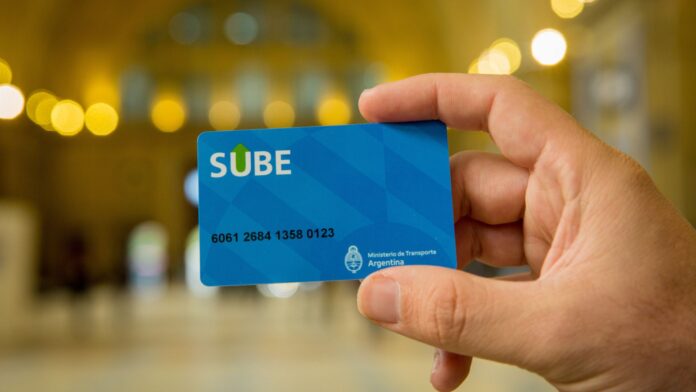
The Sistema Único de Boleto Electrónico (Unique Electronic Ticket System, better known for its SUBE acronym) became ubiquitous in Buenos Aires City and the metro area after it was launched in 2009, replacing cash and other forms of payment.
However, recent changes in legislation have left it in a bit of a limbo, and the card could be about to drop from the Buenos Aires tourist must-have list very soon.
New payment methods for public transport The possibility of paying for public transport with something other than a SUBE card was announced in August 2024, when decree 698/2024 allowed for “other means of payment to allow interoperability.”
The first to hop on board was Buenos Aires City mayor Jorge Macri. On December 1, 2024, he announced that the city’s underground, known as the “Subte,” would begin accepting payment through debit and credit cards, as well as other contactless payment methods, using Near Field Communication (NFC) systems.
That opened up the possibility of ditching the SUBE card in favor of any contactless payment alternative, with the payment being charged to your credit card or bank account, instead of having to top up the card like before.
Several companies jumped in on the new payment system, offering discounts and cashback promotions for those who used it, and its popularity skyrocketed. According to a Buenos Aires City report, 35% of all subway trips are paid via alternative methods such as cards or digital wallets on mobile phones, via contactless NFC payments or QR codes.
In January 2025, the system was opened up to some bus lines in the city and metro area, and by May it was adopted by all lines that operate exclusively in the city.
Some services that cross the boundaries between Buenos Aires City and the Buenos Aires Province — known as “national services” — have also adopted the new payment systems.
Where can you use alternative payment methods? Currently, all subway lines, Buenos Aires City bus services and some in the metro area accept payment by debit or credit card, and NFC contactless or QR codes on mobiles, as well as the SUBE.
That means that, for all intents and purposes, the SUBE has become redundant for those looking to travel within the boundaries of the city.
Several bus lines travelling exclusively outside of the Buenos Aires City — those numbered over 200 — have also started accepting the new payment methods, although non-SUBE payment may not be available across all buses or branches, so caution is advised.
Additionally, buses in Córdoba, Mendoza, Santa Fe and a further 13 provinces are also accepting alternative payment. Be sure to check if the service you need is available here.
In the Buenos Aires metro area, the only transport that is yet to include other forms of payment is the national trains service. If you’re planning a trip using any of the seven lines, you will need a SUBE card to get on board.
There’s currently no information on if and when alternative payment methods will become available.
How can I top up my SUBE? You can top up at SUBE points around the city, but make sure you bring cash. If you need to use debit and credit cards, SUBE attention centers will take them. You can also purchase the SUBE card there.
These can usually be found at subway and train stations and community centers around Greater Buenos Aires. Find a list of your nearest one here.
SUBE cards can also be topped up using a number of digital wallets such as MercadoPago and Modo, but all require an Argentine DNI to create an account.
Digital payments need to then be validated on your card, which can be done through an automatic terminal found at stations and SUBE centers, or on any mobile phone with an NFC system and the SUBE app.
They can also be validated on board buses. To do this, tell the driver “Quiero acreditar una carga” (I want to validate a top-up) and touch the card on the payment terminal. This only works in districts where Carga a Bordo (Onboard Top-ups) is available.
SUBE cards need to be registered, otherwise you’ll have to pay higher fares on all trips. Registering your card also allows you to transfer credit onto a new SUBE if yours is lost or stolen, as well as view your journey history.
You can register your SUBE online on the official website, in person at SUBE attention centers, or by phone (0-800-777-7823, option 3, Monday to Friday, 8 a.m. to 8 p.m.). Cards can also be registered through the SUBE app.
If you’ve run out of money on your SUBE, the system allows for a negative balance, with a maximum of AR$1,200, and lower limits of AR$480-650 on trains.
As of December 1, 2025, the minimum fares for registered SUBE cards are AR$593,52 for Buenos Aires City buses, AR$658,44 for Buenos Aires Provincial buses, AR$494,83 for national services, AR$1.206 for the subway and AR$280 for trains.
The maximum balance the card takes is AR$40,000.