By Dr. Fernando Ruiz, professor at the Ecole Royale Militaire in Belgium, and Herbert Gonçalves Marques Junior, PhD candidate, CECRI, UCLouvain, Belgium.
With the failure to sign the Mercosur agreement before the Christmas holidays, the European Union did not merely miss a major commercial opportunity: once again, it lost credibility and political stature in its claim to help shape the destiny of the Western world. In the current geopolitical context, Europe appears unable to assume genuine international leadership.
Despite our difficulties — or refusal — to acknowledge it, Donald Trump is today the only leader clearly displaying vision, leadership, and a capacity to project power regarding the direction the West is taking. By contrast, European indecision paralyzes the actions of its leaders and prevents them from asserting themselves as influential actors in an increasingly tense international environment.
The future of the Western world — including Latin American and the Mercosur countries — will therefore be largely shaped by Donald Trump, because his strategy is unmistakably clear. The “Trump Corollary” to the Monroe Doctrine provides an unambiguous illustration of this.
The National Security Strategy of the United States of America, from November 2025, states: “After years of neglect, the United States will reassert and enforce the Monroe Doctrine to restore American preeminence in the Western Hemisphere (…). We will deny non-Hemispheric competitors the ability to position forces or other threatening capabilities, or to own or control strategically vital assets, in our Hemisphere. This ‘Trump Corollary’ to the Monroe Doctrine is a common-sense and potent restoration of American power and priorities, consistent with American security interests.”
Some scholars may be tempted to view this as targeting only Chinese or Russian interference in the hemisphere. Yet the reality also concerns Europeans. It is worth recalling that this text only marginally expands the Monroe Doctrine: in its original 1823 version, its primary addressees were European powers, when President James Monroe condemned any European intervention in the affairs of the “Americas,” both North and South.
Europe’s lack of common vision Europe is paralyzed, among other reasons, by its inability to fully embrace the values that have made the United States the leader of the Western world. One of the central principles of the American model is precisely the unapologetic commitment to free market capitalism.
The U.S. National Security Strategy states this without ambiguity: “What differentiates America from the rest of the world — our openness, transparency, trustworthiness, commitment to freedom and innovation, and free market capitalism — will continue to make us the global partner of first choice.”
You may also be interested in: What’s next for the EU-Mercosur trade deal?
By contrast, Europe gropes in uncertainty around the concept of a “social market economy,” which each member state interprets more or less in its own way, without a clearly articulated common vision — either regarding the direction to take or that pursued by its European partners.
The European Union defines its objective as achieving “sustainable development of Europe based on balanced economic growth and price stability, a highly competitive social market economy, aiming at full employment and social progress, and a high level of protection and improvement of the quality of the environment,” according to Article 3 of the Treaty of Lisbon. In doing so, it recognizes markets as a mechanism for allocating resources, but relegates the core principles of capitalism itself to a secondary role.
Amazon deforestation: justification or excuse? Moreover, the recurrent invocation of differences in agricultural standards and environmental protection — particularly deforestation in the Amazon — as a justification for delaying or refusing the conclusion of the EU–Mercosur Agreement has progressively lost analytical robustness. Brazil, for instance, has developed increasingly sophisticated environmental governance mechanisms, while long-term deforestation data point to a structural decline since the early 2000s, despite episodic reversals.
These trends weaken generalized claims portraying Brazil as institutionally incapable of environmental control. In this context, normative differences and environmental concerns operate less as a substantive ecological assessment and more as a convenient political proxy — serving as a scapegoat rationale that obscures underlying trade, strategic, or domestic political considerations unrelated to environmental performance per se.
The problem, however, runs deeper. In its attempt to reconcile economic efficiency with social justice within its “social market economy” framework, Europe becomes entangled in contradictory political narratives — contradictions visible internally, but whose consequences are even more damaging on the international stage. While economic efficiency tends to generate broad consensus, the notion of social justice remains open to multiple, often conflicting interpretations, fueling debate and division within the Union.
Foreign policy, however, cannot be guided by internal considerations of “social justice” or “equity”. Instead, it must demonstrate leadership and be grounded in clearly articulated values if the European Union wishes to occupy a truly influential position on the global stage.
A political downgrade of the deal In this light, Brazilian President Lula’s call for the European Union to show “courage” can be interpreted as an implicit criticism of its lack of leadership. Brazilian diplomacy would undoubtedly have welcomed the signing of the agreement before Christmas, as a way to demonstrate to the rest of the world the importance attached to defending multilateralism.
The option put forward by Ursula von der Leyen to sign the agreement in January constitutes, in itself, a political downgrading of the deal. If time is not “infinite” to conclude an agreement negotiated over 26 years — as recalled by Paraguay’s minister of foreign relations — the European proposal to postpone the signing until January also reflects a misunderstanding of South American political rhythms.
In this part of the world, the Christmas and New Year period coincides with the beginning of the summer holidays. After 26 years of negotiations, prioritizing the European Union in January is unlikely to be at the top of the agenda for Latin American leaders, starting with Javier Milei. Added to this is the renewed interest of the United States in reclaiming leadership of the Western Hemisphere, pushing multilateralism into the background.
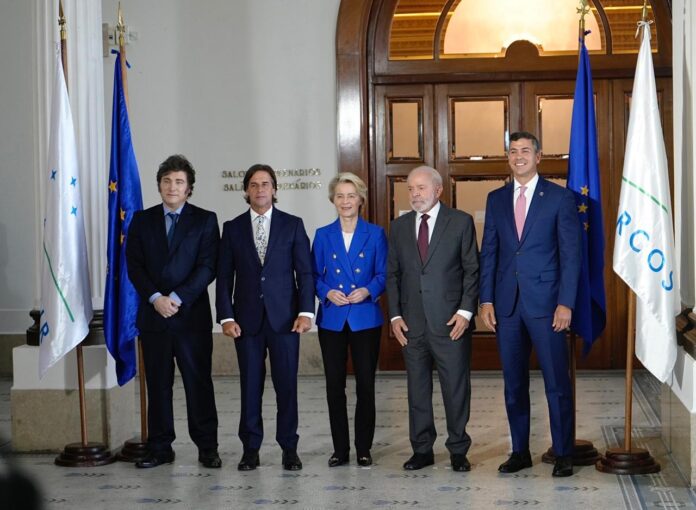
In January, if a signing does take place, the final photograph will likely be incomplete, and the agreement relegated to the status of yet another document, arriving at an inopportune moment. The European Union has likely missed a major opportunity to demonstrate leadership and defend its values within the Western world, having allowed itself to be constrained by its own internal problems.